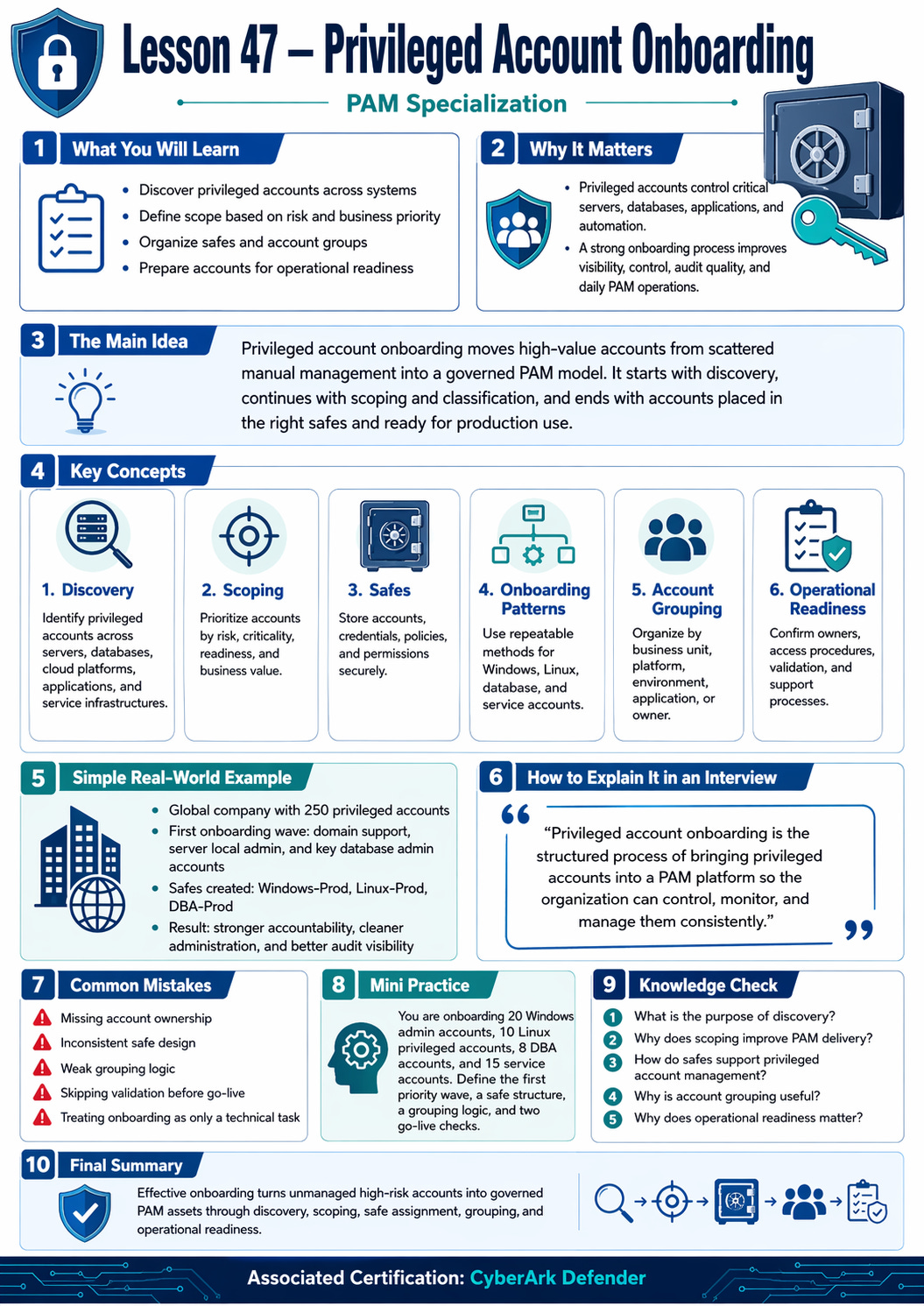
In the learning path, Lesson 47 focuses on Privileged Account Onboarding and highlights discovery, scoping, safes, onboarding patterns, account grouping, and operational readiness. It also maps this lesson to CyberArk Defender.
What You Will Learn
You will learn how organizations bring privileged accounts into a PAM platform in a structured, secure, and operationally effective way. You will understand how to identify the right accounts, define ownership, place them in the right safes, group them logically, and prepare them for daily administration.
Why It Matters
Privileged accounts control critical servers, databases, network devices, applications, and automation processes. A strong onboarding process gives security teams visibility, control, and consistency. It also supports audit quality, reduces unmanaged access risk, and strengthens daily PAM operations.
The Main Idea
Privileged account onboarding is the process of moving high-value accounts from scattered, manually managed environments into a governed PAM model. A successful onboarding approach starts with discovery, continues with clear scoping and account classification, and ends with accounts placed in the right safes and operationally ready for use.
Key Concepts
Discovery
Teams identify privileged accounts across servers, databases, cloud platforms, applications, and service infrastructures.
Scoping
Teams decide which accounts enter the PAM platform first based on risk, business criticality, platform readiness, and operational value.
Safes
Safes provide controlled storage locations for privileged accounts, credentials, policies, and permissions inside platforms such as CyberArk.
Onboarding patterns
Organizations use repeatable methods for different account types, such as Windows admin accounts, Linux root-related accounts, service accounts, and database administrator accounts.
Account grouping
Teams organize accounts by business unit, platform, environment, application, or ownership model to simplify administration and reporting.
Operational readiness
Onboarded accounts need defined owners, support processes, access procedures, validation steps, and monitoring expectations before they become part of production operations.
Simple Real-World Example
A multinational company has 250 privileged accounts across Windows servers, Linux hosts, and SQL databases. Before PAM onboarding, each infrastructure team manages passwords locally. The security team starts discovery and finds duplicated admin accounts, shared credentials, and inconsistent ownership records.
They define scope for the first onboarding wave: domain support accounts, server local admin accounts, and key database admin accounts for production. Then they create safes by environment and platform, such as Windows-Prod, Linux-Prod, and DBA-Prod. They group accounts by support team and application domain. After testing access and validating ownership, the accounts move into daily operational use through CyberArk-managed controls.
This creates cleaner administration, stronger accountability, and better visibility for audit and security teams.
How to Explain It in an Interview
“Privileged account onboarding is the structured process of bringing privileged accounts into a PAM platform so the organization can control, monitor, and manage them consistently. I would begin with account discovery, define scope based on risk and business priorities, assign the right safe structure, group accounts logically, and confirm operational readiness through ownership, validation, and support procedures. A good onboarding model improves control execution and makes PAM scalable.”
Common Mistakes
Onboarding accounts without clear ownership
Every privileged account benefits from a named business or technical owner.
Using inconsistent safe structures
A clean and scalable safe design supports administration and long-term growth.
Grouping accounts with weak logic
Logical grouping improves reporting, access management, and operational support.
Skipping validation before production use
Testing confirms that access workflows, permissions, and platform configurations support real operations.
Treating onboarding as only a technical upload
Strong onboarding includes governance, support readiness, and operational clarity.
Mini Practice
You are onboarding privileged accounts for a company with these assets:
20 Windows server admin accounts
10 Linux privileged accounts
8 database administrator accounts
15 service accounts used by business applications
Write a simple onboarding plan with:
The first group of accounts you would prioritize
A safe structure you would create
A grouping logic for administration
Two checks you would complete before go-live
Knowledge Check
What is the purpose of discovery in privileged account onboarding?
Why does scoping improve PAM delivery?
How do safes help with privileged account management?
What makes account grouping useful in daily operations?
Why does operational readiness matter before production onboarding?
Final Summary
Privileged account onboarding turns unmanaged high-risk accounts into governed PAM assets. The process includes discovery, scope definition, safe assignment, onboarding patterns, account grouping, and operational readiness. When teams do this well, they create stronger access control, clearer ownership, and a more scalable privileged access service.
Associated Certification
CyberArk Defender