What you will learn
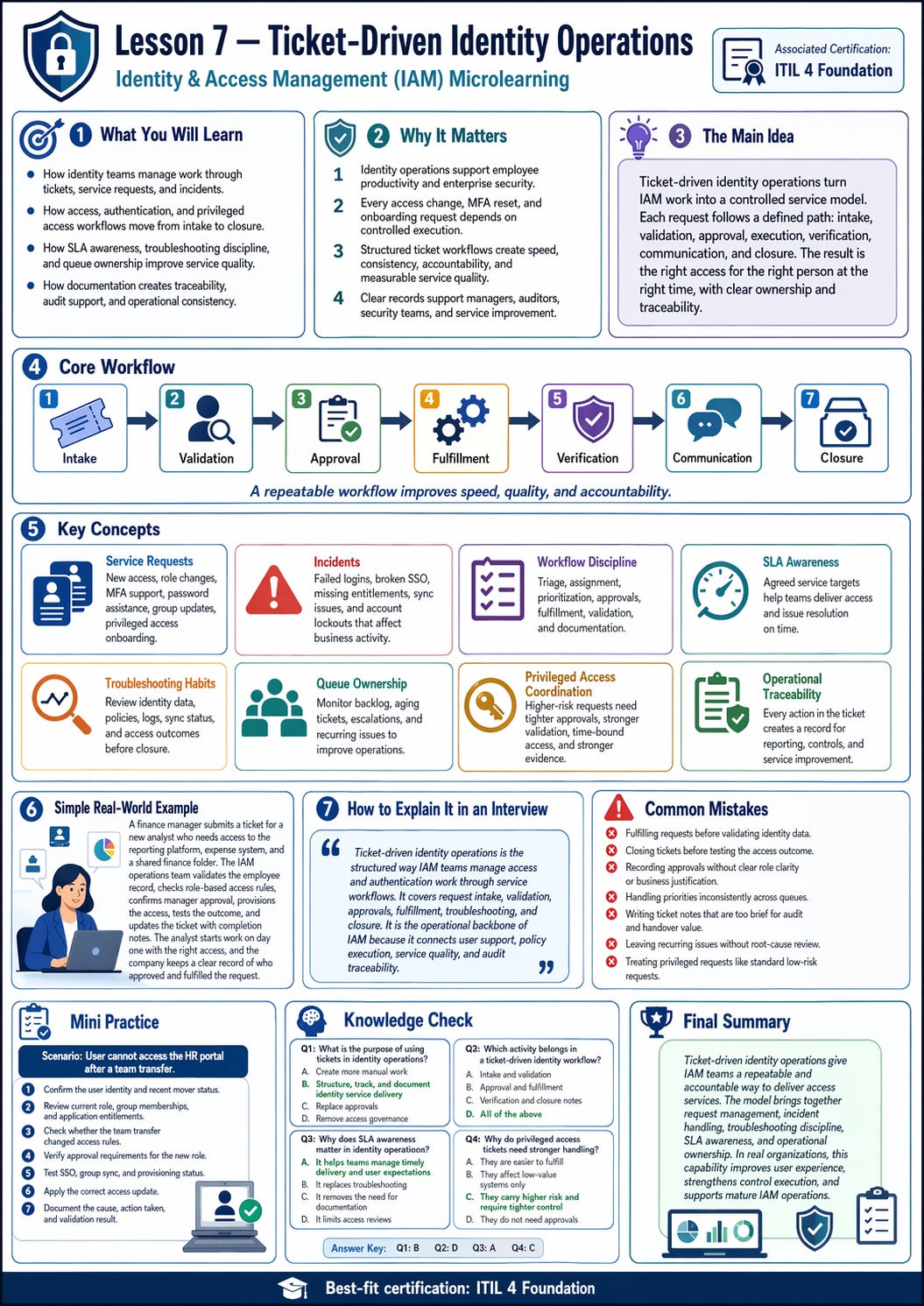
You will learn how identity teams manage access work through tickets, service requests, incidents, and operational queues. You will understand how structured workflows support access requests, authentication issues, privileged access coordination, and reliable service delivery.
Why it matters
Identity operations sit at the center of employee productivity and enterprise security. Every access request, MFA reset, onboarding action, role update, and privileged access need moves through an operational process. Strong ticket-driven operations create speed, consistency, traceability, and confidence for users, managers, auditors, and security teams.
The main idea
Ticket-driven identity operations turn identity work into a controlled service model. Each request follows a defined path: intake, validation, approval, execution, verification, communication, and closure. This structure helps teams deliver the right access to the right person at the right time with clear accountability and measurable service quality.
Key concepts
Service requests: These include new access, access changes, MFA enrollment support, password assistance, group membership updates, and privileged access onboarding.
Incidents: These cover issues such as failed logins, broken SSO, missing entitlements, sync errors, or locked accounts that affect business activity.
Workflow discipline: Identity teams follow standard steps for triage, assignment, prioritization, approval checks, fulfillment, validation, and documentation.
SLA awareness: Service-level targets help teams deliver access and resolve issues within agreed timeframes, which supports business continuity and trust.
Troubleshooting habits: Analysts investigate root causes, verify identity attributes, confirm policy alignment, review logs, and validate results before closure.
Queue ownership: Mature identity teams monitor ticket backlogs, aging requests, escalation paths, and recurring issue trends to improve service performance.
Privileged access coordination: High-risk requests often require tighter approvals, additional validation, time-bound access, and stronger audit evidence.
Operational traceability: Every action inside the ticket creates a record that supports reporting, control evidence, and service improvement.
Simple real-world example
A finance manager submits a ticket requesting access for a new analyst to the reporting platform, expense system, and a shared finance folder. The identity operations team reviews the request, validates the employee record, checks role-based access rules, confirms manager approval, provisions the required access, tests the outcome, and updates the ticket with completion notes. The analyst starts work on day one with the correct access, and the company keeps a clear record of who approved and fulfilled the request. This is ticket-driven identity operations in practice.
How to explain it in an interview
“Ticket-driven identity operations is the structured way identity teams manage access and authentication work through service workflows. It covers request intake, validation, approvals, fulfillment, troubleshooting, and closure. I see it as the operational backbone of IAM because it connects user support, policy execution, service quality, and audit traceability. In a strong model, every ticket moves through a repeatable process with clear ownership, SLA awareness, and documented evidence.”
Common mistakes
Teams fulfill requests without validating identity data.
Analysts close tickets without testing the access outcome.
Approvals lack role clarity or business justification.
Priority handling becomes inconsistent across queues.
Ticket notes stay too brief for audit and handover value.
Recurring issues remain in the queue without root-cause review.
Privileged requests follow the same handling pattern as low-risk requests.
Mini practice
You receive a ticket that says: “User cannot access the HR portal after team transfer.”
Practice the workflow:
Confirm the user identity and recent mover status.
Review current role, group memberships, and target application entitlements.
Check whether the team transfer changed access rules.
Verify approval requirements for the new role.
Test SSO, group sync, and provisioning status.
Apply the correct access update.
Document the cause, action taken, and validation result.
Final summary
Ticket-driven identity operations gives IAM teams a repeatable and accountable way to deliver access services. It brings together request management, incident handling, troubleshooting discipline, SLA awareness, and operational ownership. In real organizations, this capability improves user experience, strengthens control execution, and creates the service habits that support mature IAM teams. Lesson 7 focuses on operational support, request fulfillment, troubleshooting discipline, SLA awareness, and service ownership habits.
Associated certification
ITIL 4 Foundation — the best-fit certification for this lesson because it aligns closely with service workflows, incident and request handling, operational discipline, and service ownership in ticket-driven identity environments.