What you’ll learn
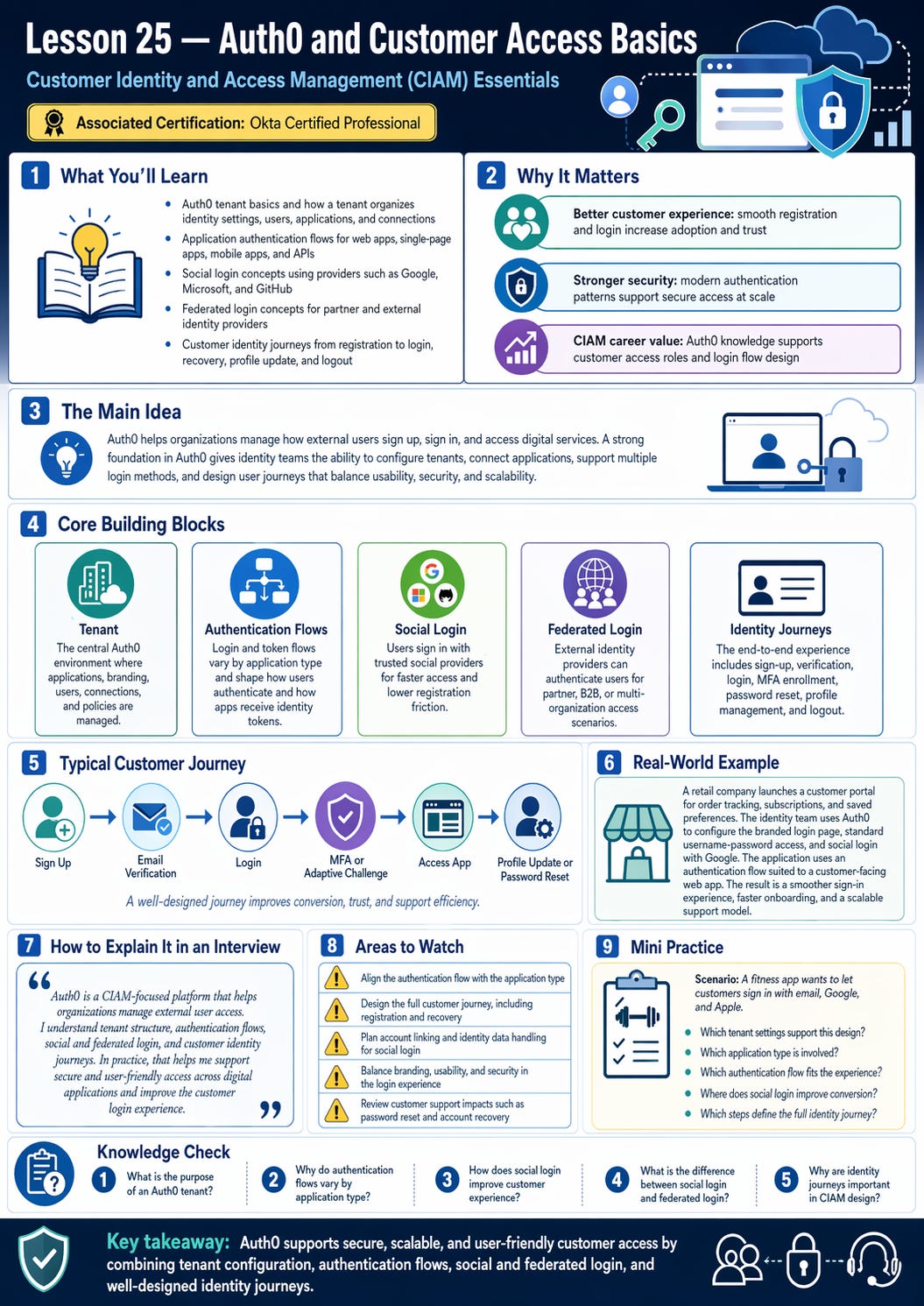
You will learn the basics of Auth0 as a customer identity platform, including tenant structure, application authentication flows, social login, federated login, and the design of customer identity journeys. You will also understand how this lesson supports customer access work and aligns with CIAM-oriented roles.
Why it matters
Organizations use customer identity to make registration, login, and account access smooth, secure, and scalable. In many CIAM roles, teams need professionals who understand Auth0 and can support customer access experiences across websites, apps, and digital services. This lesson matters because the roadmap links Auth0 knowledge to customer access support and login flow understanding.
The main idea
Auth0 helps companies manage how external users sign up, sign in, and move through digital services. A strong foundation in Auth0 gives you the ability to understand the tenant, connect applications, configure login options, and shape user journeys that balance usability and security.
Key concepts
Auth0 uses a tenant as the main environment where identity settings, applications, users, connections, and branding are managed.
Application auth flows define how a web app, SPA, mobile app, or API handles login and token exchange.
Social login allows users to authenticate with providers such as Google, Microsoft, or GitHub.
Federated login allows users to authenticate through an external identity provider, often for business-to-business or partner scenarios.
Identity journeys describe the end-to-end customer path, such as sign-up, email verification, login, MFA enrollment, password reset, profile update, and logout.
In practice, these concepts help identity teams deliver secure and user-friendly access for customers rather than employees.
Simple real-world example
A retail company launches a customer portal where users can track orders, manage subscriptions, and save payment preferences. The identity team uses Auth0 to create the login experience. The tenant contains the portal configuration, branded login page, social login with Google, and a standard username-password option. The application uses an authentication flow suited to a customer-facing web app. The result is a smoother registration and login experience, faster sign-in, and a cleaner support model for the service desk.
How to explain it in an interview
“Auth0 is a CIAM-focused identity platform that helps organizations manage external user access. I understand the core building blocks such as tenant setup, authentication flows, social and federated login, and customer identity journeys. In a business setting, that means I can support secure and user-friendly customer access across applications, help teams choose the right login approach, and contribute to better sign-in experiences.”
Common mistakes
Treating customer identity like workforce IAM without adapting the experience for external users.
Choosing an authentication flow without understanding the application type.
Adding social login without mapping the user journey and account-linking logic.
Focusing only on login success without reviewing registration, recovery, and profile management.
Configuring identity options without considering branding, friction, and customer experience.
Mini practice
Imagine a fitness app that wants to let customers sign in with email, Google, and Apple.
Ask yourself:
Which Auth0 tenant settings would support this?
What application type is involved?
Which authentication flow fits the app experience?
Where would social login improve conversion?
What steps shape the full identity journey from registration to password reset?
Knowledge check
What is the purpose of an Auth0 tenant?
Why do authentication flows vary by application type?
How does social login improve a customer experience?
What is the difference between social login and federated login?
Why is the identity journey important in CIAM design?
Final summary
Lesson 25 focuses on Auth0 and customer access basics. The core of the lesson is understanding the Auth0 tenant, application authentication flows, social login, federated login, and identity journeys. These skills support customer access operations and build readiness for CIAM-oriented roles where login flow understanding and external identity experience are valuable.
Associated certification
Okta Certified Professional