What You Will Learn
In this lesson, you will learn how modern identity systems connect users, applications, and organizations through federation protocols. You will understand the purpose of SAML, OAuth 2.0, OpenID Connect, and SCIM. You will also learn how tokens, claims, assertions, and provisioning flows support secure access and smooth user experiences across enterprise environments.
Why It Matters
Federation protocols sit at the center of modern IAM. They allow companies to connect internal apps, SaaS platforms, partner environments, and customer-facing services with consistent authentication and identity data exchange. In real organizations, this knowledge supports app onboarding, partner integrations, SSO delivery, user provisioning, and troubleshooting of login and access issues. Lesson 18 maps directly to those market-facing skills.
The Main Idea
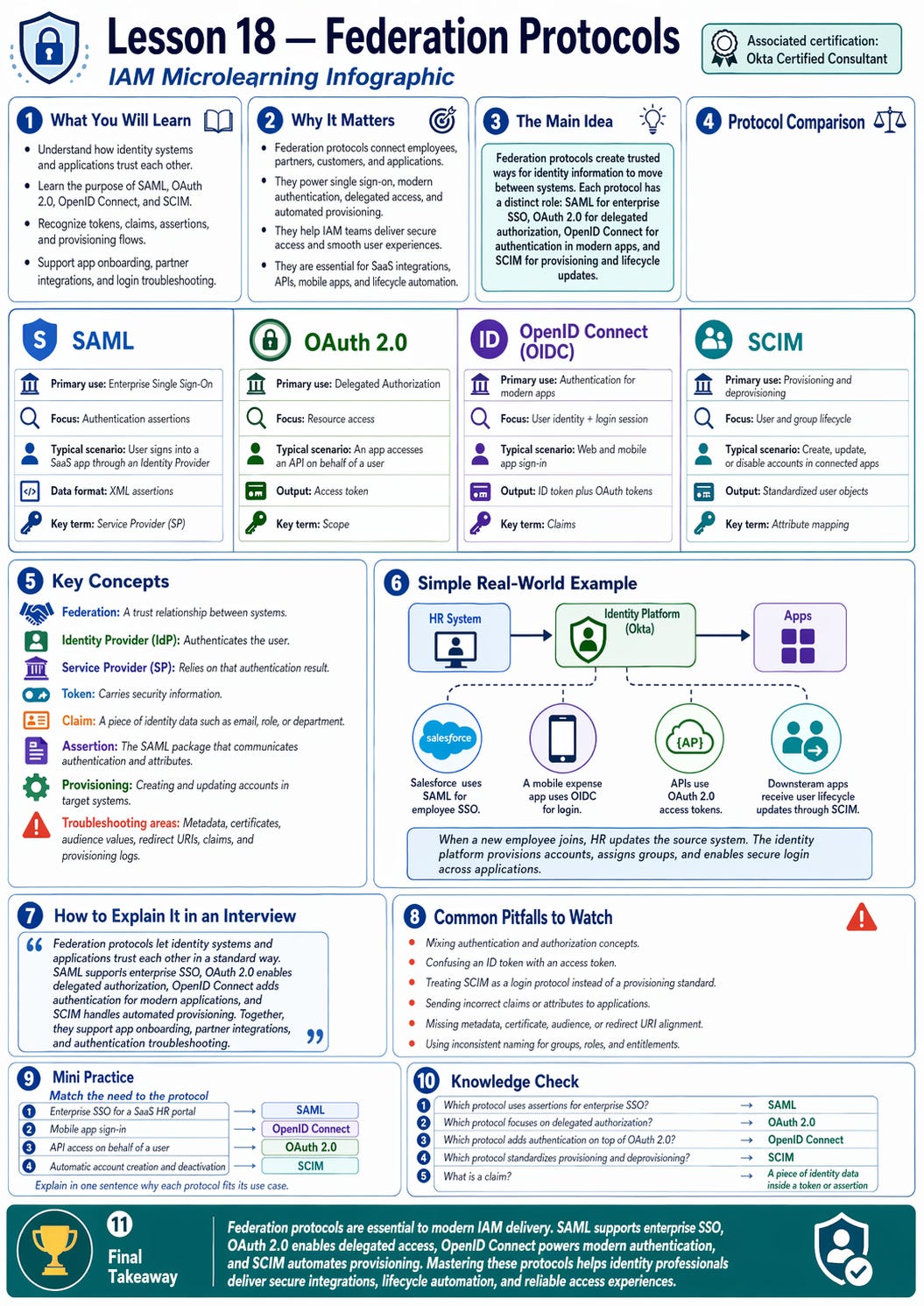
Federation protocols create trusted ways for identity information to move between systems.
Each protocol serves a distinct purpose:
SAML supports enterprise SSO using XML-based assertions.
OAuth 2.0 enables delegated access to resources through access tokens.
OpenID Connect (OIDC) adds authentication and identity information on top of OAuth 2.0.
SCIM standardizes user and group provisioning between identity platforms and target applications.
Together, these protocols help identity teams deliver secure access, automate lifecycle changes, and support reliable integrations across many systems.
Key Concepts
1. Federation
Federation is the trust relationship between systems that allows one system to authenticate a user and another system to accept that result.
2. Identity Provider and Service Provider
An Identity Provider (IdP) authenticates the user.
A Service Provider (SP) or application relies on that authentication result to grant access.
3. SAML
SAML is common in enterprise SaaS integrations. It exchanges authentication data through assertions. A SAML assertion often includes the user identity, group information, and access-related attributes.
4. OAuth 2.0
OAuth 2.0 focuses on authorization. It allows an application to access a resource on behalf of a user through an access token. This is common in API and mobile application scenarios.
5. OpenID Connect
OIDC extends OAuth 2.0 for authentication. It introduces the ID token, which contains identity information about the authenticated user. OIDC is widely used in modern web and mobile applications.
6. SCIM
SCIM handles provisioning rather than login. It creates, updates, and deactivates user accounts and group memberships in connected applications.
7. Tokens, Claims, and Assertions
A token carries security information.
A claim is a piece of identity data inside a token, such as email, department, or role.
An assertion is the SAML structure that communicates authentication and attribute information.
8. Troubleshooting Federation
Common support activities include validating metadata, checking certificates, reviewing audience values, confirming redirect URIs, validating claim mappings, and tracing provisioning failures. These tasks align closely with the lesson’s role focus: federation support, OAuth, OIDC, SAML troubleshooting, partner integrations, and app onboarding.
Simple Real-World Example
A company uses Okta as its Identity Provider.
Employees access Salesforce through SAML for single sign-on.
A mobile expense app uses OpenID Connect to authenticate users.
The same app calls APIs using OAuth 2.0 access tokens.
User creation and department-based group updates flow automatically into downstream apps through SCIM.
When a new employee joins, HR updates the source system. The identity platform provisions the account through SCIM, assigns the right group memberships, and enables login through SAML or OIDC depending on the application. This creates a joined-up identity experience across onboarding, authentication, and access.
How to Explain It in an Interview
You can explain it like this:
“Federation protocols allow identity systems and applications to trust each other in a standard way. SAML is common for enterprise SSO, OAuth 2.0 supports delegated authorization, OpenID Connect adds authentication for modern applications, and SCIM handles automated provisioning. In practice, this helps with app onboarding, partner integration, user lifecycle automation, and login troubleshooting across enterprise platforms.”
Common Mistakes
Treating OAuth 2.0 as a full authentication protocol instead of an authorization framework
Mixing up ID tokens and access tokens
Assuming SCIM handles user login rather than account provisioning
Sending incorrect claims or attributes to applications
Overlooking metadata, certificates, redirect URIs, or audience values during setup
Using inconsistent naming for groups, roles, and entitlements across systems
Mini Practice
Your company wants to integrate three services:
A SaaS HR portal that needs enterprise SSO
A mobile app that needs modern login and API access
A collaboration platform that needs automatic account creation and deactivation
Match the right protocol to each need:
HR portal: SAML
Mobile app login: OpenID Connect
Mobile app API access: OAuth 2.0
Collaboration platform provisioning: SCIM
Now explain why each protocol fits its use case in one sentence.
Knowledge Check
Which protocol is most associated with enterprise SSO using assertions?
Answer: SAMLWhich protocol focuses on delegated authorization?
Answer: OAuth 2.0Which protocol builds on OAuth 2.0 to support authentication?
Answer: OpenID ConnectWhich protocol standardizes user provisioning and deprovisioning?
Answer: SCIMWhat is a claim?
Answer: A piece of identity data carried inside a token or assertion
Final Summary
Federation protocols are essential to modern IAM delivery. SAML supports enterprise SSO, OAuth 2.0 enables delegated authorization, OpenID Connect provides authentication for modern apps, and SCIM automates provisioning. Mastering these protocols gives you practical capability in app onboarding, partner integration, authentication troubleshooting, and lifecycle automation. That makes Lesson 18 a core step for access engineers and identity consultants working across modern identity platforms.
Associated Certification
Okta Certified Consultant